Industry Insight | June 2026
The tattoo industry is experiencing one of the most significant technological shifts in its history. Artificial Intelligence (AI), once considered a futuristic concept, is rapidly becoming an essential tool for artists, studios, and manufacturers worldwide.
As client expectations continue to evolve, tattoo professionals are seeking faster design workflows, more personalized artwork, and improved consultation experiences. AI-powered design platforms are helping meet these demands by accelerating creative development while opening new possibilities for customization.
A New Era of Tattoo Design
Traditionally, tattoo design has relied heavily on an artist's experience, drawing skills, and creative interpretation. The process often involved multiple rounds of sketches and revisions before reaching a final concept.

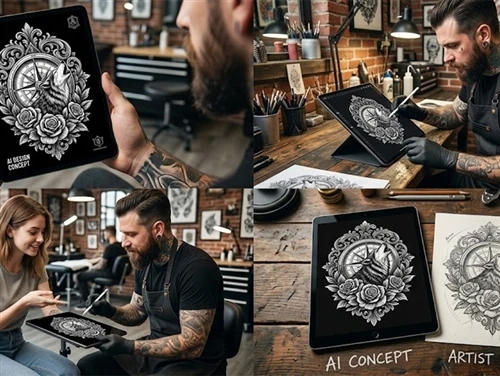
Today, AI can generate dozens of design variations within seconds based on a simple text prompt.
Whether a client requests a cyberpunk wolf, a Japanese-inspired sleeve, or a highly personalized memorial piece, AI tools can quickly produce visual concepts that help both artist and client explore creative directions more efficiently.
Rather than replacing artistic talent, AI is increasingly being used as a creative assistant that accelerates ideation and improves communication.
Improving Client Consultations
One of the biggest challenges in tattoo design has always been translating a client's vision into artwork.
Clients often struggle to describe exactly what they want, while artists must interpret abstract ideas and personal stories into visual designs.
AI-generated imagery is helping bridge that gap.
By generating multiple visual concepts during the consultation process, artists can provide clients with immediate references, making discussions more productive and reducing the number of revisions required before approval.
As a result, studios are seeing improvements in both efficiency and customer satisfaction.

Personalization Reaches New Levels
Customization has always been at the heart of tattoo culture.
AI is enabling artists to combine multiple design elements faster than ever before.
Family symbols, geometric patterns, pet portraits, watercolor effects, traditional motifs, and modern artistic styles can now be merged into highly personalized concepts within minutes.
Artists remain responsible for refining these concepts, ensuring anatomical accuracy, artistic quality, and long-term wearability on the skin.
The technology serves as a starting point-not the final result.
Will AI Replace Tattoo Artists?
Despite growing interest in AI-generated artwork, industry professionals largely agree on one point: AI will not replace tattoo artists.
Creating a successful tattoo involves far more than generating an attractive image.
Artists must consider body movement, muscle structure, skin texture, placement, composition, and healing behavior.
They also bring emotional understanding, cultural awareness, and artistic judgment that AI cannot replicate.
Most importantly, the actual tattooing process requires technical skill, experience, and real-time decision-making that remains uniquely human.
Impact on Tattoo Studios
Studios adopting AI-assisted workflows are already reporting several benefits.
Design development cycles are becoming shorter, allowing artists to spend more time tattooing and less time creating preliminary sketches.
Increased efficiency also enables studios to handle a larger volume of consultations without sacrificing quality.
Many artists additionally report that AI-generated concepts help overcome creative blocks by providing fresh visual perspectives and unexpected design combinations.
Beyond Design: AI and Tattoo Equipment
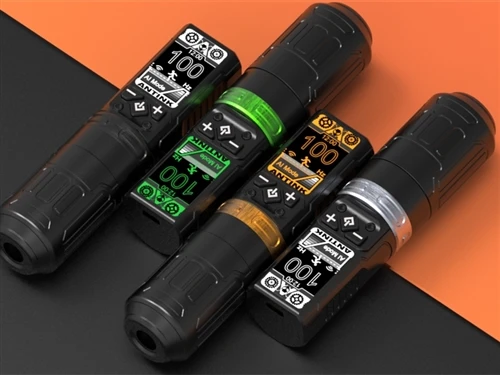
The influence of AI is extending beyond artwork creation and into tattoo equipment development.
Industry experts predict that future tattoo machines may incorporate intelligent features such as:
- Real-time performance monitoring
- Smart power management
- Session data recording
- Adaptive operating parameters
- Workflow analytics
As digital technologies continue to mature, tattoo equipment is expected to become more connected, precise, and user-focused.
New Opportunities for Distributors
For distributors and wholesalers, AI-driven innovation represents more than a technological trend-it represents a business opportunity.
Professional artists are increasingly looking for products that offer enhanced functionality, improved user experiences, and clear technological differentiation.
As a result, distributors can benefit from expanding product portfolios that include advanced wireless machines, modular systems, and digitally integrated solutions.
Looking Toward the Future
Over the next five years, AI is expected to become a standard component of tattoo design workflows.
Much like digital photography transformed the camera industry and drawing tablets changed commercial illustration, AI is poised to become an everyday creative tool.
The most successful tattoo professionals are unlikely to be those who rely entirely on artificial intelligence.
Instead, success will belong to artists who effectively combine human creativity, technical expertise, and AI-powered efficiency.
Conclusion
Artificial Intelligence is redefining how tattoo designs are created, presented, and refined.
By accelerating concept development, improving client communication, and supporting greater personalization, AI is helping studios operate more efficiently while enhancing the overall customer experience.
At the same time, the core elements of tattooing-artistic vision, craftsmanship, and human connection-remain irreplaceable.
For tattoo studios, equipment manufacturers, and global distributors, the message is clear: those who adapt early to technological innovation will be best positioned for long-term growth.
AI will not replace tattoo artists-but it will empower great artists to achieve even more.