
Dateline: NEW YORK, May 26, 2026 - A growing number of tattoo artists are questioning the battery specifications printed on wireless tattoo machines, arguing that a higher mAh rating does not translate into longer continuous working time - and that inflated marketing claims are fueling a new source of professional stress known as "battery anxiety."

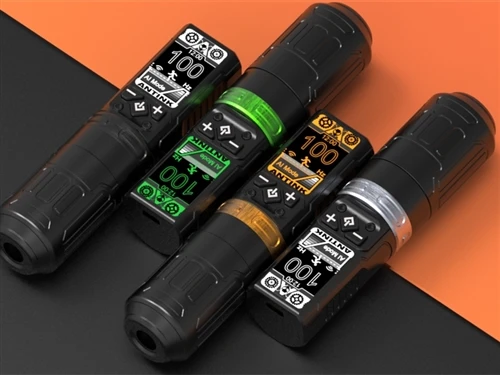
A wireless tattoo pen with a digital display showing voltage and battery level resting at an artist's workstation
The frustration surfaced prominently in an online forum for tattoo artists in May, when one user reported that a two-week-old wireless machine's large battery lasted six hours while its smaller battery died in just 2.5 to 3 hours - both at the same 8-volt setting. "Is this supposed to be normal?" the artist asked, noting that the batteries had been advertised as lasting at least six hours each.
The responses suggested the problem is widespread. "My shader runs a small battery all day, 7.5 to 8 hours. My packer burns through the same battery in 2.5 to 3 hours," one artist replied. Another confirmed they routinely prepare a second battery for sessions lasting five hours, despite advertised runtimes. A third said all of their batteries from a single manufacturer had eventually failed.
According to technical analyses from equipment suppliers, the disconnect stems from the fact that battery life is not a fixed figure but the product of multiple interacting variables. A 2026 technical report from a professional equipment distributor states plainly that "runtime is not a fixed number printed on a spec sheet." Manufacturer-claimed hour figures, it notes, typically reflect low-voltage, intermittent-use laboratory conditions and "often exceed real-world results by 20 to 40 percent."
Voltage is the single largest factor. Every one-volt increase raises current draw noticeably, compressing runtime. Fine linework at 5.5 to 6.5 volts draws far less than color packing at 7.5 to 9 volts. Needle grouping matters too: large magnum cartridges present higher mechanical resistance than small round liners, increasing motor load. Stroke settings, skin resistance, motor type, and even ambient temperature all shift the equation further.
"Voltage drop on a wireless machine is not just a technical phrase. It is a working problem," wrote one equipment manufacturer in an April 2026 analysis titled "Wireless Tattoo Machines: Sacrificing Power for Portability?" The company described "the quiet stress of battery anxiety halfway through a big piece," adding that a 10-volt setup driving a large magnum will naturally drain faster than a 7-volt setup running a 3RL liner.
A tattoo artist preparing two charged batteries for a long session as part of a rotation workflow
The industry's recommended response is a "two-battery workflow" - one battery running the machine, one charged and staged nearby. Rather than waiting for a battery to fail mid-line, artists are advised to swap at planned break points: after finishing a section, before starting a long line pass, or after a wipe-down. The same distributor describes "spare-battery choreography" as the most effective safeguard, recommending at least two fully charged batteries for any booking longer than three hours, plus a wired RCA or L-connector as a professional fallback.
Equipment makers are also beginning to address the transparency gap. A separate 2026 setup guide from one manufacturer urges artists to treat the battery as a "system component," while another notes that batteries are typically the first part of a wireless setup to show their age, with capacity declining gradually over hundreds of charge cycles. "A shorter runtime is a battery problem. It's not a sign the machine itself is wearing out," that manufacturer states.
Industry data suggests lithium-ion cells retain roughly 80 percent of capacity after about 500 charge cycles, translating to roughly 12 to 18 months of daily professional use. An estimation formula rarely circulated among suppliers advises dividing a battery's mAh rating by average current draw in milliamps, then multiplying by a usable-capacity factor of 0.75 to 0.80 - and planning sessions around just 70 percent of the resulting figure to account for voltage sag late in a charge.
For artists, the practical takeaway is that workflow planning beats spec-sheet numbers. "The goal is not to use every minute of battery power. The goal is to finish each stage with stable output," wrote one machine maker in a May 2026 guide, recommending a spare battery for medium pieces of three to five hours and full rotation planning with a wired backup for sessions exceeding five hours.
As cordless machines continue to dominate studio work in 2026, the gap between advertised capacity and usable runtime is emerging as a defining industry issue - one that suppliers, artists, and manufacturers will have to close before "battery anxiety" becomes a permanent fixture of the profession.